
Why Skilled People Hoard Tools, and What to Do About It
by a.huynh |
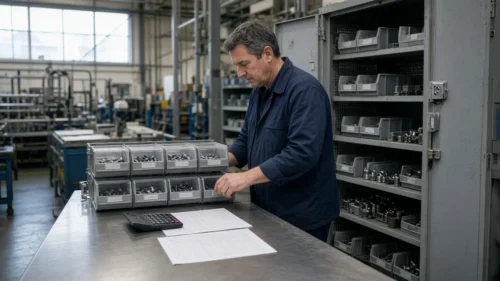
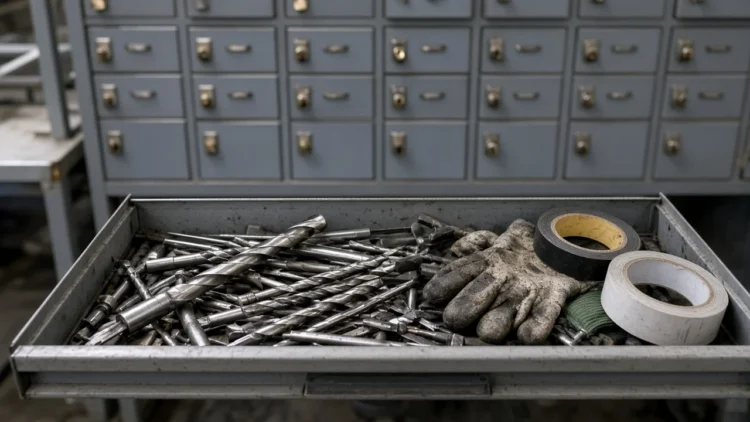
Walk a machine shop after the shift has started and you will find two stores. One is the official crib, with its bin locations, its shortage list and its slightly defensive supervisor. The other is unofficial, and it lives in pedestal drawers, locker bottoms, the back of a toolbox and the gap behind a machine guard. Gloves, inserts, drill bits, tape, batteries and the occasional gauge sit there because someone capable decided that the official system could not be trusted with the next job.
Tool hoarding in manufacturing is often described as a discipline problem. It is more accurately a supply problem with a human face. People who are paid to keep a machine running will build a private buffer the moment the shared buffer has failed them twice. Lectures about company property do not remove that memory. A reliable issue point does.
Hoarding is a rational response to an unreliable stores
A setter who has stood at a crib window while a job waited, or who has opened a bin labelled for the right insert and found it empty, learns a simple lesson. The next time the item is available, take more than the job needs. Hide the surplus where the next shortage cannot reach it. From the setter’s side of the machine, that is professionalism. From the company’s side, it is inventory that has left the system, demand that has been distorted, and a min-max level that now replenishes a ghost.
The same pattern appears with personal protective equipment. If the glove size that fits is missing on Monday, it will be missing in someone’s locker by Tuesday, in quantities that would have covered the whole cell. Maintenance engineers do it with batteries, fuses and the particular fitting that stores never quite keeps. Quality technicians do it with consumable styli and the last calibrated gauge that was actually where the board said it was.
None of this requires a culture of theft. It requires uncertainty. When people believe the next issue will be slow, wrong or embarrassing, they insure themselves. The insurance premium is paid in working capital, in expired or damaged stock, and in the quiet friction between stores and the floor.
Where the cost actually sits
The cash tied up in private drawers is the obvious loss, and it is rarely the largest one. Distorted demand does more damage. If ten people each quietly hold a week’s worth of an insert, the crib looks busier than the machines are. Purchasing raises the reorder point. The official bin overflows. Meanwhile a night shift that was not part of the original hoard still runs out, because the recorded stock and the usable stock are no longer the same number.
There is a quality cost when the hoarded item is the wrong grade, an outdated revision, or a gauge that has slipped past its calibration date in a drawer nobody audits. There is a safety cost when gloves and respiratory protection are stored in the heat of a locker rather than in the conditions the manufacturer specified, or when a harness lives in a van instead of being inspected on a cycle. There is a fairness cost, which supervisors feel even when they cannot quantify it. The people who follow the process are the ones who wait. The people who hoard are the ones who keep running. A system that rewards the second group will get more of them.
Search time belongs in the same account. A private stash only saves time for the person who built it. Everyone else still hunts, and the person who built it eventually hunts as well, because an unlabelled drawer is not a location system. It is a memory, and memories decay across rotating shifts.
Why a crackdown fails
The instinctive response is a clear-out. Supervisors announce an amnesty, drawers are emptied onto a table, and a stern note goes up about unauthorised stock. For a fortnight the crib looks healthier. Then the same uncertainty reasserts itself and the drawers fill again, this time with more secrecy because people have learned that visibility is punished.
Amnesties are useful. They are not a control system. Punishment aimed at hoarding treats a competent employee as the defect. The defect is the gap between the moment a person needs an item and the moment the organisation can prove it will be there. Close that gap and the private buffer loses its purpose. Leave the gap open and no amount of signage will keep it empty.
There is a second failure mode, which is to make the official route slower in the name of control. Countersignatures, paper permits and a single crib window on days only will reduce recorded issues. They will increase unofficial ones. Control that cannot keep up with the pace of the work is not control. It is a suggestion.
Make the official supply more trustworthy than the stash
Trust is built from a few visible promises, kept every shift. The item is at the point of use, so nobody walks past three bays to collect a glove. The item is the right one, because the compartment, the locker or the weigh bin will only present what that person is allowed to take for that job. The item will be there tomorrow, because replenishment is triggered by the issue itself rather than by a weekly visual check that somebody missed.
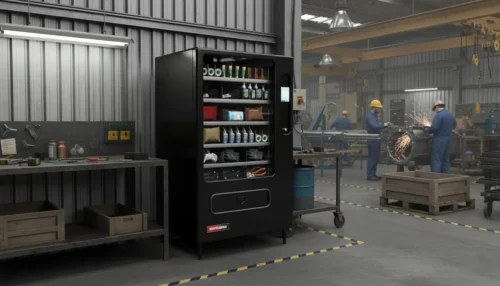
A SmartDrawer at the cell, or a SupplyVend locker where returnable tools and higher-value kit need a name against them, makes those promises enforceable. The screen asks for an identity. The compartment that opens is the one that should open. The transaction exists whether the shift is supervised or not. People test a new system in the first week. If it opens quickly and contains the thing they came for, the drawer at the machine starts to look like unnecessary risk rather than insurance.
Bulk and low-value items need the same honesty in a different format. Locking a cupboard of fasteners or welding consumables with an E-Lock still records who entered and can still drive a replenishment, without forcing every washer through a helix coil. The principle does not change with the hardware. The official location has to be nearer, faster and more reliable than the secret one.
Limits that feel fair
Once supply is trustworthy, limits become acceptable. A limit that bites while the bin is empty feels like rationing. A limit that bites while the bin is full feels like housekeeping. Set the allowance against the real job: a quantity per shift, per work order or per week, high enough for legitimate variation and low enough to stop a trolley load leaving “just in case”.
Publish the rule. Let supervisors see exceptions, because a crashed tool or a contaminated batch of gloves is a real event and the system should record it as an exception rather than force someone to work around it. Charge the issue to a cost centre or a job so the conversation in the morning meeting is about consumption, not about character. When a cell’s glove usage doubles, the useful question is what changed in the work, not which person is greedy.
Returnable assets need a different promise. People hoard gauges and powered tools because bringing them back has historically meant losing them to someone else. A check-out that names the holder, chases the overdue item and guarantees a calibrated replacement will come back out of the same locker gives the holder a reason to return. The record is the reassurance.
What changes in the first quarter
Expect the recorded consumption of the controlled items to rise before it falls. That rise is the unofficial stock coming back into view, and it will unsettle anyone who reads the first month as a failure. After that, issues usually settle towards the true rate of use, stockouts become exceptions worth investigating, and the reorder points can be lowered because they no longer have to feed both the machine and the myth.
Give people a route to hand stock back without a lecture. A short amnesty at go-live, with the returned product checked and put into the cabinet, fills the system with the very items the floor already proved it needs. It also signals that the past buffer was understandable. The new expectation is simply that the buffer now lives in a location everyone can see.
Supervisors should walk the cabinets, not the drawers, for the first month. Their presence tells the floor that this is the store that matters. A cabinet that is full, fast and fairly limited will empty the pedestal drawers without a campaign. A cabinet that is empty, slow or arbitrary will fill them again by Friday.
The aim is not a factory without a single spare insert near a machine. A sensible setter will always keep the tool that is in the cut. The aim is a factory in which the shared system is the place people trust with everything else, because it has earned that trust on every shift, including the one with no manager on site.
Sources and further reading
Tooling Intelligence, SmartDrawer