

The Second Life of a Cutting Tool: Reconditioning Only Works If You Can Count
by a.huynh |
A solid carbide end mill does not become waste the first time it goes dull. In a well-run toolroom it becomes a candidate for regrind or a fuller reconditioning, then a second candidate, and sometimes several more, before the remaining body is no longer worth a new edge. In a poorly run toolroom the same cutter goes into a scrap tin, or into a drawer, because nobody can say how many times it has already been back, which machine used it, or whether the geometry the programmer expects is still the geometry in the box.
That gap is now expensive enough to manage on purpose. Sandvik Coromant has stated publicly that its solid round tools can be reconditioned up to three times and still maintain their original performance, and that reconditioning a tool three times typically delivers at least 50 per cent saving compared with buying new. The company is careful about the limit: tools may go further if quality still meets the need, and the three-cycle figure is the promise, not a suggestion that every cutter in every shop can be treated as identical. The commercial point for a UK manufacturer is simpler. The saving is real only for tools whose history you can trust.
Why good cutters are thrown away
Cutters are small, numerous and easy to treat as consumables even when the unit price says otherwise. A setter under pressure will put a fresh tool in the spindle rather than argue about a regrind queue. A tool that comes back from reconditioning without a link to its previous life is just another cutter in a bin, and the next person has no reason to believe the diameter, the coating or the number of cycles. Programmers then add a margin, or they ban reconditioned tools from finishing passes, and the economic case collapses because the reconditioned tool has been demoted to roughing or to the scrap tin.
Loss does the same damage. A cutter that never returns to the crib cannot be reconditioned, however attractive the supplier’s portal looks. The circular loop is a physical loop. Issue, use, return, assess, send, receive, issue again. Break any step and the 50 per cent lives in a brochure.
There is also a quality fear, and it deserves respect. A tool that has lost diameter will cut a different feature unless the program, the offset or the application knows. Reconditioning that is not tied to an identity is a good way to make scrap that costs more than the cutter. The answer is identification and a rule for where a reconditioned tool may be used, not a blanket refusal to recondition anything.
Count lives, not just purchases
The record you need is modest. A unique identity or a tightly controlled batch for the cutters you think are worth a second life. The number of issues, or a better proxy such as recorded cutting time where you have it. The number of reconditioning cycles already consumed. The diameter or the stated remaining geometry if the process depends on it. A status: in stores, issued, out for reconditioning, quarantined, scrapped, recycled.
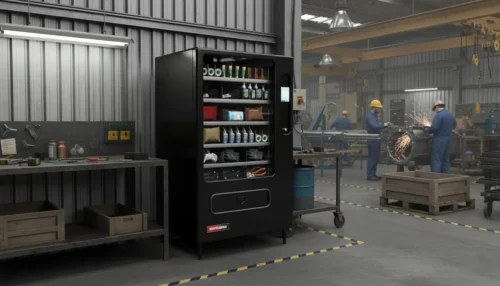
Point-of-use issue is what keeps that record attached to the real world. If the cutter leaves a SmartDrawer or a locked compartment against a person and a job, you know it went into the factory. If the return is a step, not a favour, you get it back while it can still be assessed. In a precision engineering shop, where the same families of solid round tools recur, that loop is enough to separate “buy another dozen” from “three of these have one cycle left and four are already off site”.
Sandvik Coromant’s own reconditioning service has been built around the same idea. A portal in which the customer enters the product code and quantity, receives a quotation, and can see how many times a tool has been reconditioned, exists because the cycle count is the planning fact. Matthew Johnson, the company’s product manager for reconditioning, has described a target turnaround of 21 days from the point the order is sent, with shipping, taxes and tariffs covered for the majority of markets. Whatever supplier you use, the lesson is the turnaround and the count. A 21-day loop only feeds production if you sent the tool before the compartment was empty, which means the cycle count has to trigger the shipment rather than a panic.
Decide the policy before the tin is full
Write a one-page policy for the families you will recondition. Which tools are in scope, by value and by how often they are used. How many cycles you will accept before a review, using the supplier’s guarantee as a ceiling rather than as an automatic target. Which operations may use a reconditioned tool, and which still require new. Who is allowed to scrap, and what happens to the body afterwards. A recycling or buy-back route for true end of life, which Sandvik Coromant pairs with its reconditioning offer, is the clean last step. A drawer of dead carbide is not a recycling policy.
Agree the inspection you will do on return from the supplier. Trust the process, and check it. Diameter, visual edge, identity still readable. A tool that fails does not go back into the compartment “because the job is waiting”. It goes into quarantine, and the supplier hears about it with the identity attached.
Then connect the policy to the minimum stock. A tool with one cycle remaining is not the same as a new tool, and the compartment should not pretend it is. Some shops hold a small new-tool buffer specifically so reconditioning lead time never puts a finishing operation at risk. That buffer can be much smaller than a policy of using everything once. The cash released is the difference between those two stocks, repeated across every family on the list.
What the programmer and the buyer each need
The programmer needs to know that a reconditioned tool in a given family still matches the offset strategy. If reconditioning changes diameter, the identity that comes back must say so, and the people at the machine must see it before the tool goes into the changer. Surprises at the spindle are how a sustainable initiative gets banned by production.
The buyer needs a price comparison that includes the real loop. New tool price, against reconditioning price, freight if it is not covered, the internal time to collect and assess, and the expected cycles. A 50 per cent saving quoted by a manufacturer is a prompt to run that sum on your own top twenty cutters, not a number to paste into a budget for tools the shop will never send back. If the sum works, the buyer should stop treating every cutter line as a simple repeat purchase. Some lines are a service contract with a turnaround. They need a forecast, which the issue history can provide.
Scrap and rework sit on the same page. A tool used past its life because the new one was out, or because a tired regrind was mixed into the new-tool bin, will spend its saving on a scrapped part very quickly. Segregation is part of the saving. New, cycle one, cycle two, quarantine. If those cannot be told apart at the point of issue, they will be told apart at the inspection bench, which is late.
A quarter’s worth of proof
Choose the cutter family with a painful annual spend and a willing cell. Mark them, issue them only through the cabinet, and insist on return. Send the first dull batch while you still have cover. When they come back, use them under the rule you wrote, and record cycle two as deliberately as cycle one. At the end of the quarter, compare purchases of that family with the previous quarter and with the number of cycles you actually bought. Include any quality escapes. A clean result is fewer new tools, no rise in scrap, and a queue for reconditioning that is planned rather than heroic.
Then add the next family. Circular tooling is not a poster about waste. It is a stock policy in which a cutter has a number of lives, each life is visible, and the last life ends in a recycling stream instead of in a drawer. ## Coatings, diameters and the limit of the loop
Not every cutter should enter the loop, and saying so protects the ones that should. Very small tools, tools whose coating is the whole point of the application, and tools used on a feature with a tight unfinished tolerance may still be single-use by policy. Put that policy in writing so a well-meant regrind does not create a quality escape that ends the programme. For the families that remain, agree how diameter change is communicated. A reconditioned tool that returns in the same sleeve, with the same code, and a different cutting diameter, is a latent scrap event. Identity has to survive the journey, on the tool or on the packaging the cabinet sees, and the compartment for cycle two should not be the compartment for new if a glance cannot tell them apart.
Turnaround is part of tool life planning. A stated 21-day reconditioning loop, of the kind Sandvik Coromant has set as its aim from the moment the customer sends the order, means the dull tool must leave while you still have a cycle in the cupboard. Sending it when the cupboard is empty converts a 50 per cent saving into an expedited new-tool purchase plus a reconditioning invoice for a cutter that will arrive after the job has gone. The issue history tells you when the send should happen. Someone has to be named to make the shipment on that date.
There is an environmental report in the same record, and it should stay modest. You can say how many cutters in a family were reconditioned rather than bought new, and how many reached a recycling route at the end. You should not inflate that into a carbon figure you have not calculated. Customers and group sustainability teams are increasingly willing to hear a physical count. They are increasingly unwilling to hear an unsupported conversion. The count you already need for the saving is the count you can stand up in that conversation.
The manufacturers who capture the saving are the ones who can count.