

Releasing Working Capital Tied Up In Indirect Manufacturing Inventory and MRO Stores
by a.huynh |
When manufacturers talk about inventory, they usually mean the material that becomes the product. Raw stock, components, work in progress and finished goods sit on the balance sheet in numbers the finance director already watches. The other inventory is easier to underestimate. Cutting tools, fasteners, adhesives, PPE, maintenance spares, gauges and the small hardware that keeps a line change possible are often spread across a crib, a maintenance store, a cage at the back of the cell and a set of drawers that do not appear on anyone’s cycle count.
That spread is why indirect inventory survives cost-cutting exercises that take a hard look at finished goods. It is individually cheap, collectively large, and operationally frightening to reduce. Nobody wants to be the person who removed the spare that would have restarted the line. So the stock stays, the cash stays with it, and the carrying cost is rarely given a name.
Make UK’s second-quarter 2026 outlook adds a reason to name it. Firms were lifting output, with the survey balance moving from +21% to +26%, while confidence sat at its lowest since the end of 2022 and businesses were building stocks of critical inputs. Investment intentions remained positive and, in Make UK’s words, slowed sharply, with the investment balance at +8%. In a period when people are holding more of what they fear they might not get, the discipline is to hold the right things. Indirect stock is where “just in case” goes to live forever.
What it costs to hold the stock you already own
There is no single official benchmark for inventory carrying cost, and it is a mistake to pretend otherwise. The Institute for Supply Management, writing in its Monthly Metric series, describes carrying cost as having four families of component: the capital tied up, including financing; service costs such as insurance and the systems that manage the stock; risk costs such as damage, theft, depreciation and obsolescence; and storage and handling, whether the building is yours or someone else’s. ISM’s practical observation is that there is no consensus benchmark, although many companies aim to keep the total somewhere between 20 and 30 per cent of inventory cost, and that the percentage rises as more of those components are honestly included.
The useful act is to build the figure for your own crib rather than to import one. Take the inventory value you are prepared to defend, after a count that includes the cages and not only the official bins. Apply a cost of capital your finance team recognises. Add the space, which is often the corner of a high-value production building rather than a cheap warehouse. Add a frank obsolescence rate. Indirect items obsolesce when the machine leaves, the specification changes, or the glove standard is updated and three shelves of the old one remain because nobody has the heart to scrap them. Add loss, which in an open store is not a theoretical shrinkage percentage. It is the difference between what you bought and what the machines and the people can account for.
Even a cautious local figure changes the conversation. Stock that felt prudent at its purchase price looks different when each pound sitting there has an annual cost attached, and when a portion of it has not moved since the last layout change. The aim is not a heroic write-off. The aim is to stop replenishing the portion that is standing in for a process you do not trust.
Why the crib overstates what you need
Open and semi-open stores inflate their own minimums. Issues are invisible, so usage is inferred from purchases. Purchases include the product that was hoarded, duplicated and lost. The minimum rises to cover a demand that was partly the store feeding itself. Lead time is padded because the last emergency is more memorable than the last calm month. Safety stock is then added on top by someone who does not trust the minimum. The result is a store sized for a worse factory than the one you have.
A second distortion is variety. Every well-meant substitution, every “equivalent” fastener, every glove that a single supervisor prefers, becomes a location. Each location needs a minimum if it is treated as critical. Criticality spreads until everything is critical and nothing is managed. Reducing variety, with engineering and safety in the room, often releases more cash than shaving a percentage off the items you keep.
A third distortion is the maintenance spare held against a story. The story may be true. It should still have a date, a machine and an owner. Spares held against machines you no longer run, or against a failure mode that a redesign removed, are sentiment. Sentiment is an expensive stocking policy.
See consumption, then lower the water
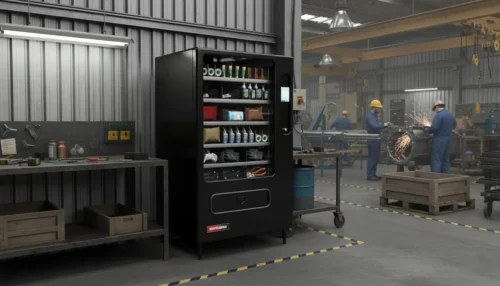
The safe way to release cash is to make consumption visible before you reduce stock. Put the movers, the high-value items and the items you expedite most often under controlled issue, at the point of use where that is what stops the walk and the workaround. A SmartBin approach, watching weight rather than asking a busy technician to count, suits bulk fasteners and similar lines. Drawer and locker control suits the items where identity and quantity matter one by one. An E-Lock suits the cage of larger spares that will never fit a coil, while still recording access and triggering replenishment.
For a few months, resist the urge to slash. Let the issues describe true demand, including the seasonality of shutdown and the lumpiness of a particular contract. Then set minimums from that demand and from a lead time you have checked with the supplier, not from the lead time in a field nobody has opened since 2019. The stock you can remove is the stock above that newly evidenced minimum, plus the stock that did not move at all.
Non-movers need a decision, not a new label. Use them on a job, return them, sell them, or scrap them. Leaving them in a “review” location is how they re-enter the minimum at the next audit. Finance should see the release as a one-off cash benefit and the lower replenishment as the ongoing one. Operations should see that the items which do move are now harder to run out of, because attention has been taken off the items which do not.
A rule for the stock you are tempted to build
The present habit, visible in the Make UK survey, of securing critical inputs is understandable. Apply it with a list. Critical means a stopped process and a lead time you cannot compress, not a mild inconvenience and a supplier who delivers weekly. For the critical list, a higher cover can be a deliberate choice, reviewed on a date. For everything else, building stock because the news feels uncertain is how indirect inventory undoes the cash you were trying to protect.
Share the list with suppliers where the relationship allows. A supplier who understands which twenty items you will not risk, and which two hundred you intend to stop buffering, can plan capacity without you paying to warehouse their catalogue. Vague anxiety orders the catalogue. A named list orders the risk.
Put the saving where the next decision can see it
Indirect inventory rarely has a single owner. Production wants availability, maintenance wants cover, purchasing wants a lower purchase price, finance wants cash. The carrying-cost number gives them a shared unit. Review it quarterly, on the same list of families, and show on-hand value, issues, stockouts and non-movers together. A reduction in on-hand value that coincides with a rise in stockouts is a failure. A reduction that coincides with stable issues and fewer emergencies is the result you were after.
Capital requests get easier once this picture exists. A cabinet, a weigh bin or a lock that costs a known amount, set against a carrying cost and a loss rate you have calculated locally, is a calmer proposal than a promise of “efficiency”. In a year when investment plans are slowing, the projects that release cash while protecting uptime are the ones that still get signed.
An illustrative sum, for the conversation rather than the budget
A worked example helps the first meeting, provided everyone can see that the inputs are local placeholders. Suppose a crib holds £80,000 of indirect stock that finance accepts as a fair count. Suppose the signed carrying-cost rate, once capital, space and a modest obsolescence allowance are included, is 20 per cent. The annual cost of holding that stock is £16,000 before anyone discusses a single stockout. If a quarter of the value has not moved in a year, £20,000 is a candidate for use, return or disposal, and the carrying cost falls in the following year only if you also stop reordering it. None of these figures is a benchmark. They show the shape of the sum. Replace every input with your own before the number goes near a forecast.
Class the list before you apply the sum to every bin. A small number of lines will hold most of the value, and a long tail will hold most of the locations. The valuable lines deserve a minimum based on real issues and a lead time you have checked. The tail deserves variety reduction and, for many lines, a decision to stop stocking altogether and to buy against a known job. Treating the tail with the same safety stock as the critical lines is how a crib becomes a catalogue you happen to own.
Cycle counting then changes job. Count the lines that move and the lines you have decided are critical. Stop spending the same effort proving the quantity of items you already intend to remove. The count is there to keep the cash figure honest, not to dignify dead stock with a precise unit quantity.
The crib is not a junk drawer and it is not a strategic reserve. It is a set of items with different jobs. Name the cost of holding them, watch the ones the work actually uses, and let the rest stop quietly consuming the cash the business is short of.
Sources and further reading
APQC, Inventory carrying cost as a percentage of inventory value (definition of the measure)
Make UK, Manufacturing Outlook, Quarter 2 2026
The £80,000 worked example in the article is illustrative only and is not a benchmark.