

From Min-Max to Foresight: Using Tool Dispense Data Before the Next Run
by a.huynh |
A minimum stock level is a promise made to the past. It says that if consumption continues to look roughly like last quarter, and if the lead time stays roughly like last quarter, the bin should not empty. That promise holds on a steady product mix. It frays the moment the planner loads a harder material, a new revision, or a short batch of a job the cell has not seen since autumn. The insert that was comfortable at a minimum of twenty becomes the insert that stops the machine on Thursday afternoon.
Make UK’s Manufacturing Outlook for the second quarter of 2026 describes a sector that is still producing, and still uneasy. The reported balance for output rose from +21% to +26%, while confidence has fallen to its lowest level since the end of 2022. The same survey notes businesses building stocks of critical inputs because access feels less certain than the current order book. In that climate, a blunt increase in every minimum is one response. A more precise response is to read what the factory has already consumed, and to stage the specific tools the next run will actually need.
Dispense data, the record of who took which item, when, and against which job or cost centre, is the raw material for that staging. It is more current than an annual usage figure and more honest than a stores count that cannot see the drawers.
What a dispense record contains
Every controlled issue can carry a small set of facts. The item identity, the quantity, the person, the time, the location of the cabinet, and the reason code or work order if you ask for one. Over a few months those facts describe a rhythm: which inserts a cell burns on a particular material, which gloves move at the start of a shutdown, which gauge leaves every time a named job is booked.
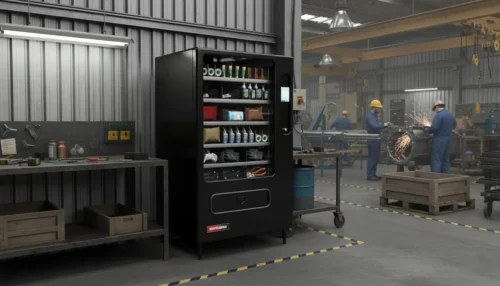
A SupplySystem style of control, running from replenishment through to the point of use, is what makes the rhythm visible in one place. The cabinet is the sensor. Purchasing sees the same event the setter created, without waiting for a bin card to be interpreted on Friday. The point is not a larger report. The point is a record that is complete enough to compare this run with the last run of the same kind.
Incomplete records are the usual reason the data disappoints. If people still bypass the cabinet for the expensive items, the history describes the compliant work and misses the work that matters. If work-order entry is optional and usually skipped, you can see volume and you cannot see cause. A short, enforced reason, even a job family rather than a full routing number, is enough to make the history useful. Perfect ERP integration can come later. A credible issue event has to come first.
Why the minimum level arrives late
Min-max is a rear-view calculation. Usage over a review period, divided into a daily rate, multiplied by lead time, plus a safety factor somebody agreed in a meeting. It is the right tool for items whose demand is smooth. Gloves on a stable headcount, a standard drill used every day, a fastener on a repetitive assembly: these can live happily on a minimum.
It is the wrong sole tool for items whose demand arrives in steps. A batch of a wear-resistant alloy, a prototype run, a customer audit that suddenly requires a particular gauge, a night of rework after a fixture problem. The step does not show up in the average until after it has happened, which is when the average is no longer the problem. The problem is the empty compartment and the expedite.
Safety stock is how companies paper over that lateness. Extra stock covers ignorance of the next step. Sometimes the ignorance is unavoidable. Often the next step is already on the planner’s board, and the tooling implication has simply not been translated. The planner knows the material. The programmer knows the tool library. Stores knows neither, until the setter arrives.
Reading a run before it starts
The practical move is a short pre-run check that joins the plan to the dispense history. For a job family you have run before, the history says which items left the cabinet last time, in what quantity, over what elapsed cutting time. Scale that by the new batch size, then compare it with what is in the compartment today and with what is already on order. The gap is a staging list, not a surprise.
For a job you have not run, borrow the nearest history and be honest about the difference. A harder material, a longer stick-out, a dry cut instead of a flood coolant, a new coating: ask the programmer which tools in the library are at risk and stage those, rather than lifting every minimum in the cabinet. The dispense record then captures the new job so the second run is no longer a guess.
Spikes deserve a different reading. If a machine starts taking a cutter at twice its recent rate, the cabinet is often the first place the change appears, ahead of the scrap bin and ahead of the maintenance log. The cause might be a programming change, a material certificate that does not match the label, a fixture pulling the part off centre, or a tool that is being run past its life because nobody is tracking life. The dispense event does not diagnose the cause. It tells a supervisor where to stand. Caught here, the conversation happens before a shift’s worth of parts is in dispute.
Siemens’ True Cost of Downtime 2024 report put a scale on why that timing matters for large manufacturers. Across the world’s 500 biggest companies, unplanned downtime was estimated at about 11 per cent of revenues, around $1.4 trillion. At the top end, an idle automotive line in a major plant was costed at about $2.3 million an hour. Most UK plants are not that plant. The structure of the loss is the same at a smaller scale: the hour is expensive because the recovery, the reset and the missed sequence cost more than the missing insert. A signal that arrives before the hour starts is worth more than a precise post-mortem.
Stockpiling is not the same as staging
The Make UK survey’s observation on stock building is easy to misread. Holding more of everything feels like resilience when export orders have slowed and input access feels fragile. Export orders in that quarter’s balance fell from +18% to +8%, while UK orders improved modestly. Firms that answer uncertainty by lifting every reorder point will trap cash in the variant they do not run, and still run out of the variant they do.
Staging is selective. It puts the tools for the booked work at the cell, in the quantity the last comparable run consumed, with a named owner for anything that has to come back. It leaves the slow movers on their ordinary minimum. The cabinet makes the difference visible, because you can see that the staged items moved against the jobs you intended, and that the protective bulk did not quietly migrate into personal drawers.
Vendor conversations improve at the same time. A supplier who can see forthcoming staged demand, rather than a sudden expedite, can hold the right coating or the right gauge without you paying to own every possibility. The data has to be specific. “We are busy” is not a forecast. “This cell issued 40 of this insert the last time we ran this family, and the plan shows two more batches in the next three weeks” is a forecast a supplier can act on.
Start with one cell
The temptation is a site-wide analytics project. Resist it until one cell produces a history you believe. Choose a cell with a repeating job mix, a willing supervisor and a cabinet that people actually use. For four weeks, insist on issue against a simple job family. At the end of the month, take three forthcoming jobs and write the staging list by hand from the history. Compare it with what the old minimum would have provided. The gaps you find are the business case for doing the same thing on the next cell.
Keep the review short and regular. A weekly look at exceptions, items issued far above their recent pattern, items not issued at all despite a job that should have used them, overdue returns, will do more than a quarterly dashboard nobody opens. The exception list is where programming, quality and stores meet. It should be short enough to finish in the time between shifts.
Over a quarter, the minimum levels you do keep will get better, because they will be based on issued quantity rather than on purchases into a crib that leaks. The levels you no longer need will show themselves as stock that never moves when the plan is full. That is cash you can stop holding, without taking a risk you cannot see.
Foresight, in this sense, is not a prediction engine. It is the habit of reading a record you already paid to collect, before the setter is standing at an open, empty compartment with a job on the screen and a spindle doing nothing.