
5S on the Shop Floor: Why Tool Control Foam Fails Without a Control Loop
by a.huynh |
Most factories can show you a photograph of 5S. A shadow board with every spanner outlined, a drawer of two-tone tool foam, a floor marking that was straight on the day the auditor walked through. Fewer factories can show you the same board on a Thursday night, three months later, with the same tools present and the same outlines still telling the truth. The method is not at fault. The sustain step is where visual control either becomes a habit or becomes décor.
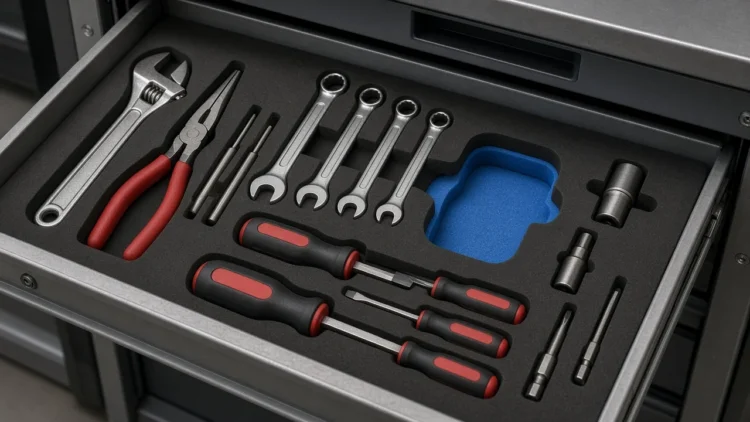
Precision-cut tool control foam is one of the clearest expressions of “set in order”. A recess cut to the tool, with a contrasting colour underneath, means a missing item announces itself. That announcement is only useful if somebody is accountable for the answer. An empty pocket that everyone walks past is a label that has lost its meaning. This is how to keep the meaning, and where foam should stop and a controlled store should start.
What the five steps are asking for
5S came out of the need to make a workplace readable. Sort removes what the job does not need, including the duplicate, the broken and the “we might”. Set in order gives what remains a defined home that matches the sequence of the work. Shine is inspection as much as cleaning, because wiping a tool down is when damage, wear and the wrong item in the wrong pocket become obvious. Standardise locks the first three steps into a method other shifts can repeat. Sustain is the management system that keeps the standard from depending on one enthusiastic supervisor.
Visual control belongs in the second and fifth steps. The foam insert, the shadow board and the marked square on the bench are devices for making a normal condition obvious and an abnormal condition impossible to miss. They do not, by themselves, create the standard. A precision-cut foam insert can show that a torque wrench is absent. It cannot say who had it, whether it is still in calibration, or whether it has left the hangar. Those questions need a process sitting behind the colour contrast.
Teams that treat 5S as a housekeeping week get the photograph and lose the system. Teams that treat it as a way to see problems early get fewer lost tools, faster handovers and a quieter argument at the start of the shift. The difference is whether an empty pocket triggers a known response.
Why night shift undoes a day-shift standard
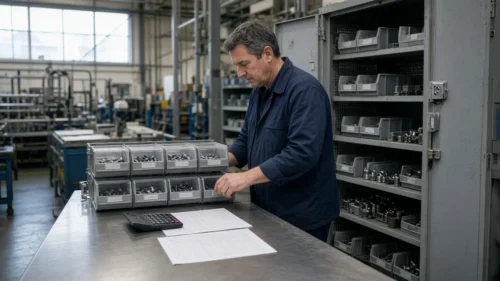
A standard designed by days, for days, will be rewritten by nights within a fortnight. The night crew may be smaller. The stores window may be shut. The tool that days keeps on a shadow board may be the tool nights have to take to a breakdown in another bay. If the only way to do the job is to break the board, the board will be broken, and the people who break it will be the ones keeping the plant running. Blaming them for a standard that ignored their work is how 5S gets a reputation as theatre.
Design the home for the tool around the full pattern of use. If a kit leaves the cell, its home might be a closed case with its own insert, not an open board that looks wrong the moment the kit is doing its job. If three shifts share one set, the standard has to include a handover: the pocket is full, or the tool is named against a person and a time. Without that, the incoming shift inherits a mystery and solves it by fetching a duplicate from somewhere unofficial. Duplication is how sort quietly reverses itself.
Shine suffers in the same way. A wipe-down and a glance at the insert takes two minutes when it is built into the end of the job. It does not happen when it is a separate campaign. The insert helps here, because wear, a cracked handle or a tool put back in the wrong orientation is visible in a second. That only works if the recess still matches the tool. The moment a replacement of a different shape is dropped into an old pocket, the visual system starts lying. Re-cutting the insert is part of sustaining it, not a failure of the original.
An empty pocket has to mean something
The power of two-tone foam is binary. The tool is there, or the contrasting colour is showing. Binary signals only change behaviour when the response is also binary and understood. In a maintenance crib, the response might be “the kit is not issued until the pocket is full”. In an aerospace tool control area, the response is stricter, because a missing tool is a foreign object risk until it is found. In a general machine shop, the response might be “the setter signs the tool back before the job is closed”. Different risks, same principle: the colour is a trigger, and the trigger has an owner.
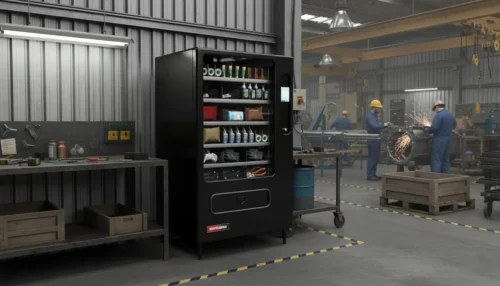
This is where foam and electronic issue support each other rather than compete. Foam makes presence and absence obvious at the scale of a kit, a drawer or a case. A controlled cabinet or locker makes custody obvious at the scale of a person and a time. A precision-cut foam kit that lives inside a locker combines both. You can see that the kit left complete, you can see who took it, and you can see that it came back complete before the locker accepts the return as finished. That combination is what turns a tidy drawer into a control loop.
Foam on its own is the right answer for kits that stay with a named owner, for presentation of a standard toolset at a bench, and for transport cases where the risk is damage and loss in transit. It is the wrong sole answer for a pool of high-value gauges that many people share, because a pretty recess cannot tell you whose bag the gauge is in. Those items need an identity against the issue.
Cut the insert around the job
The most common design mistake is to cut foam around the tools people already own, in the order they happened to lay them on the bench. The better sequence starts with the job. Which tools are used together? Which must be present before work starts? Which are calibrated, and which are consumable? What has to be visible in under five seconds at handover? The insert should follow that logic, with the critical tools in the primary field of view and the rarely used extras either removed by sort or placed where their absence is still obvious.
Leave space for the tool the job actually requires, including gloves or a lead if they are part of the controlled kit. A beautifully cut drawer that cannot hold the torque wrench with its extension fitted will be abandoned the first time someone is in a hurry. Equally, resist the urge to cut a pocket for every tool in the building. Sort is the first S for a reason. An insert crowded with maybes is harder to read than a smaller insert that matches the standard work.
Material and cut quality decide whether the standard survives contact with a factory. High-density layered foam, cut so the recess holds the tool without gripping it so tightly that people stop putting it back, will still show the contrasting colour after months of use. A soft, torn lining will not. Where the same kit is repeated across cells, cut them as a set so the standard is identical. People who move between cells should meet the same layout, or the visual cue stops being a cue.
Replacement tools are a process question. Agree in advance who is allowed to put a different tool into a pocket, and how quickly the insert is recut or the standard is formally changed. Informal substitutions are how the colour cue becomes a lie.
Audit the signal, not the tidiness
A useful 5S audit asks whether an abnormal condition would be seen and acted on. It does not award marks for straightness. On a foam insert the checks are plain. Does every pocket still match the tool assigned to it? Is a missing tool accounted for by a current issue, or is it simply gone? Has anything been added that has no recess? Can the incoming shift complete the check in the time you claim it takes?
Record the misses. A pocket that is empty on three successive audits is a process problem: either the tool is under-provided, the home is in the wrong place, or the return rule is not credible. Buying a second tool without changing the rule just creates a second thing to lose. Moving the home closer to the work, or issuing the kit from a controlled point, usually does more.
Sustain also means refreshing the standard when the work changes. New product, new fastener, new torque value: the insert and the issue rules should change in the same week as the method. An insert that reflects last year’s process is worse than no insert, because it gives false confidence.
Supervisors help by using the visual control themselves. If the morning start-up includes a ten-second look at the kit, the crew will keep it true because someone who matters looks. If the foam is only mentioned when a customer tour is due, the crew will treat it as scenery and they will be right.
Where to stop decorating and start controlling
Foam is a sensing method. It makes the state of a kit legible. It does not replenish a consumable, it does not lock a gauge that is out of calibration, and it does not know which shift had the tool last if nobody wrote it down. Use it where legibility is the gap. Pair it with controlled issue where custody, limits or calibration are the gap. Keep both tied to a response that the night shift can carry out without inventing a workaround.
Done that way, 5S stops being a periodic tidy and becomes a way of seeing the work. The empty pocket is no longer an embarrassment to be hidden before the tour. It is information, and the factory has already decided what to do with it.
Sources and further reading
Lean Enterprise Institute, Five S (definition of the method)