
Industrial Vending Machine Hire: When Renting Is the Better Capital Decision
by a.huynh |
UK manufacturers are being asked to tighten tool and consumable control at the same time as finance directors are protecting cash. Point-of-use vending usually wins the operational argument. Controlled access, a record of every issue, and stock that is replenished before a cell stops are difficult to argue against once a stores manager has lived through a week of stockouts and unofficial drawers. The funding question is less tidy. Some plants want the asset on the balance sheet. Others want a predictable hire charge and the freedom to change the hardware if the cell, the contract or the headcount moves.
Industrial vending machine hire is a different allocation of risk, tax treatment and flexibility from an outright purchase. A sound decision starts by separating the value of control from the way that control is paid for. The cabinet is a means to an end. The end is reliable issue at the point of use, with a trail that purchasing, quality and finance can all read.
What you are really funding
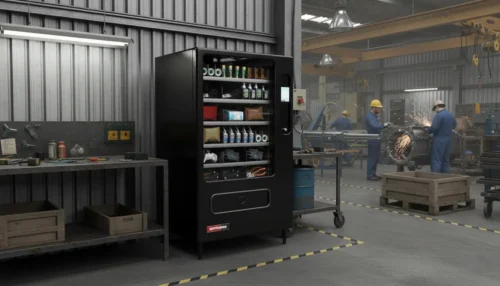
A drawer cabinet, a locker bank or a weigh-scale unit issues consumables, personal protective equipment, gauges and returnable assets beside the work. The value sits in the rules the software applies. Those rules decide who may take an item, how many they may take on a shift or a work order, which cost centre absorbs the cost, and when a replenishment should be raised. Hardware that cannot enforce those rules is a locked cupboard with a better paint finish. Hardware that can enforce them changes behaviour within a few shifts, because the easy path and the recorded path become the same path.
That distinction should sit at the centre of any hire-versus-purchase conversation. You are choosing how quickly a controlled issue point can be placed next to a cell, a maintenance bay or a contractor entrance, and how easily it can move when the work moves. A SmartDrawer configuration, for example, can be arranged around the mix of inserts, PPE and small tooling a particular area actually uses. The commercial question is whether that configuration should be owned from day one or hired while the pattern of use becomes clear.
Ownership feels decisive, and in a stable factory it often is. A long-running machine shop with a settled range of consumables, a known headcount and a stores process that will still look familiar in five years can make a credible case for buying. The asset will be sweated, the internal team will learn one system properly, and the monthly charge disappears once the kit is paid for. Hire earns its place when those conditions are softer than the business case assumes.
How a purchase is treated for tax
Tax should inform the comparison, and it should be confirmed with the company’s own adviser before anyone signs. The published rules are clear enough to frame the discussion. Companies within the charge to corporation tax can claim full expensing, a 100 per cent first-year allowance, on qualifying expenditure on new and unused main-rate plant and machinery. The allowance has been available for expenditure incurred on or after 1 April 2023 and has been made permanent. GOV.UK is explicit that the amount of qualifying expenditure is uncapped, and that a company paying the main rate of corporation tax can reduce its tax by up to 25p for every pound invested.
The same guidance sets boundaries that matter on a factory project. The asset must be unused and not second-hand. Cars are excluded. Special-rate assets follow a different allowance. Expenditure on plant or machinery provided for leasing does not qualify for full expensing, aside from a narrow exception for background plant or machinery within a building. A manufacturer buying a vending cabinet to use in its own trade is in a different position from a business buying cabinets in order to hire them out. If the company later sells an asset on which full expensing has been claimed, a balancing charge can arise.
From 1 January 2026 there is a further 40 per cent first-year allowance for main-rate plant and machinery in cases that do not fall within full expensing. HM Treasury described that relief as covering assets bought for leasing and unincorporated businesses, which do not benefit from full expensing itself. For a limited company buying a new cabinet for its own workshop, full expensing remains the more generous route where the conditions are met. For a partnership, a sole trader, or a business whose expenditure is excluded, the 40 per cent allowance changes the first-year arithmetic and should be modelled properly rather than assumed.
None of this turns a purchase into free equipment. Full expensing accelerates relief. It does not remove the cash leaving the bank on the day the invoice is paid, unless a separate finance agreement is doing that work. It also assumes the company has profits to relieve. A business investing through a thin year may care more about cash timing than about the theoretical speed of the allowance.
What hire does to cash and to the accounts
Under a hire or rental agreement the user generally does not capitalise the machine. The hire charge is a cost of running the operation, recognised as it is incurred, for as long as the agreement says the cabinet stays on site. That is often the point. A revenue cost tracks the period of benefit, which suits a project cell, a new contract of uncertain length, or a plant that wants evidence before it standardises.
There is a discipline hidden in that structure. A purchased cabinet can become invisible once it has been capitalised. It sits in the asset register, depreciates quietly, and nobody revisits whether the original compartment layout still matches the work. A hire charge appears every month in a cost centre that someone owns. That visibility keeps the conversation alive: is this unit in the right place, is it full of the right products, and is anyone actually using it? Poorly used equipment is easier to challenge when it has a monthly price.
Hire is a weak choice when the only motive is to dress up a long-term need as a short-term cost. A cabinet that will stand in the same bay for seven years, issuing the same family of inserts, should be costed as a long-lived asset. Stretching that need across years of hire, without a break clause you are willing to use, can cost more cash than a purchase even after tax relief is taken into account. The comparison has to be written down over a defined horizon, with a residual assumption, a service assumption and a realistic view of whether the layout will change.
Tooling Intelligence’s industrial vending machine hire and rental offer is built for that test. The full hardware range can be hired, which matters because a locker for returnable assets and a drawer cabinet for inserts solve different problems. A low cost of entry lets a site trial automated issue without a capital request that has to wait for the next budget round. Scalability matters just as much. A cell that starts with one cabinet and later needs an auxiliary unit should be able to grow the installation without pretending the first decision was final.
Where hire is the cleaner decision
Hire fits a short or uncertain horizon. Commissioning a new line, supporting a customer contract that may or may not be extended, or covering a shutdown and the contractor workforce that arrives with it, are all situations in which owning the peak capacity is hard to justify. When the contract ends, the cabinet should be able to leave with it.
Hire also fits a first installation in a business that has never run controlled issue before. The early months teach you which products were political, which minimum levels were guesses, and which compartment sizes were wrong. Learning those lessons on hired equipment is cheaper than learning them on a layout you have just paid to own. Once the data settles, buying the standard configuration for the next three cells is a calmer capital request, because it is backed by your own issue history rather than a supplier’s brochure.
Multi-site groups sometimes use hire as a way to prove a standard before they impose it. A single plant can run the chosen platform for two quarters, with the same item master and the same rules the rest of the group would inherit. Sister sites are much more willing to adopt a standard they can see working on a sister shop floor than a standard that arrives as a policy. Purchase can follow, site by site, once the rule set is no longer theoretical.
Cash position matters as much as accounting treatment. A manufacturer that is delaying wider capital projects, protecting a covenant, or simply waiting to see how the order book settles, can still put control in place if the route in is a hire charge that operations can fund from consumable budgets. The operational gain, fewer stockouts, fewer unofficial stashes, a cleaner replenishment signal, does not have to wait for a capital committee that meets quarterly.
Where purchase still wins
Purchase wins when the duty cycle is long, the product range is stable, and the business wants the allowance in the year of spend. A company with taxable profits, a clear specification and a maintenance plan can reasonably prefer to own. Purchase also wins when the cabinet will be modified, integrated deeply with internal systems, and treated as part of the fixed stores infrastructure in the same way as racking.
There is a people point as well. Owned equipment sometimes receives more careful adoption because the organisation has had to justify it. That is only an advantage if the justification included training, an owner for the item master, and a replenishment routine. A purchased cabinet with no owner becomes furniture. A hired cabinet with a named owner becomes a process. The contract type does not substitute for the operating model.
Service belongs in both columns. Breakdown response, software access, and someone who will reconfigure a drawer when the insert family changes are what keep the issue point honest. Whether those activities are bundled into hire or contracted beside a purchase, they should be priced in the comparison. A cheap purchase with an empty service line is not a cheap purchase.
How to run a fair comparison
A fair model covers the same horizon on both sides, commonly three or five years, and it includes the same scope. Hardware, software access, installation, training, consumables used to fill the machine, and the internal time required to maintain the item master all belong in the picture. On the purchase side, include the cash outflow, the expected allowance and the possibility of a balancing charge if you might relocate or sell. On the hire side, include the full charge, any minimum term, and what happens at the end.
Then put a value on the operational change, using your own baseline rather than a generic percentage. Count stockouts on the items you intend to control, the hours supervisors spend authorising emergency purchases, and the value of product that currently lives in personal drawers. Those numbers will be imperfect. They will still be more honest than a single industry average borrowed from a different sector. If the hire route brings that baseline under control six months earlier than the capital route, the timing has a value and it should be written down.
The decision meeting goes better when operations and finance look at the same page. Operations should bring the cell layout and the product list. Finance should bring the allowance position and the cash view. Neither side should be asked to approve a cabinet they have not seen doing the job it is being bought or hired to do.
A sensible sequence for most plants
For a first deployment, hire the configuration that matches the hardest cell, run it through a full replenishment cycle, and read the transactions before you standardise. Keep the item list short enough that the data means something. Expand only when the rules are being followed without heroics. Where the data then supports a long, stable installation, take the purchase option to the capital committee with your own evidence, and let the adviser confirm the allowance. Where the work is temporary, seasonal or still moving, leave the equipment on hire and spend the management attention on the rules rather than on the asset register.
The plants that get this wrong treat the commercial wrapper as the strategy. The plants that get it right treat hire and purchase as two ways to fund the same discipline: the right item, issued to the right person, in time for the job, with a record that still makes sense at the month end.
Sources and further reading
GOV.UK, Capital allowances: permanent full expensing
GOV.UK, HS252 Capital allowances and balancing charges (2026)
Finance Act 2026, section 29 (40% first-year allowance)
Tooling Intelligence, industrial vending machine hire and rental