
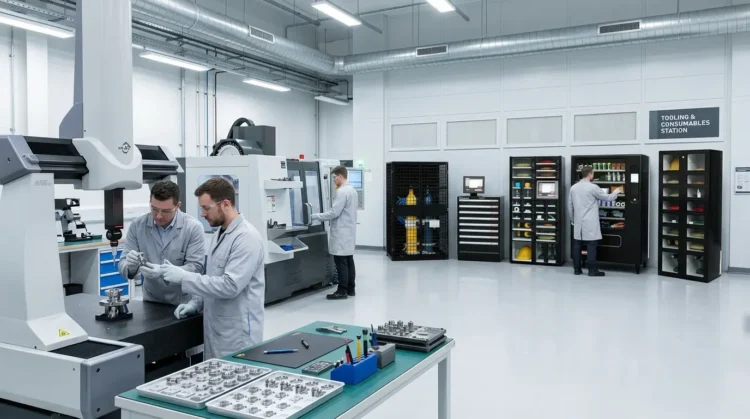
Securing High-Value Cutting Tools and Gauges in Precision Engineering
by a.huynh |
Precision engineering operates on the finest of margins. Whether machining aerospace components from solid titanium or crafting intricate medical implants, the quality of the finished product is entirely dependent on the tools used to create it. This reliance means that precision engineering facilities are filled with high-value assets, from bespoke carbide cutting tools to highly sensitive, calibrated micrometres and gauges.
However, despite the immense value of these assets, many facilities still rely on outdated, manual storage methods. Leaving expensive tooling in unlocked cabinets or open cribs is a recipe for financial waste and quality control disasters. Securing these high-value items through intelligent point-of-use vending is one of the fastest ways to protect your margins and guarantee absolute precision on the factory floor.
The Hidden Financial Drain of Poor Tool Management
When a high-value tool goes missing, the financial impact extends far beyond the cost of replacing the item itself. The true drain on profitability comes from machine downtime, wasted labour and inefficient procurement.
According to industry data published by MachineMetrics, direct tooling costs typically account for 3 to 6 percent of a company’s top-line manufacturing expenses. However, this figure assumes an efficient, well-managed process. Case studies from tooling management experts such as Gühring reveal a much harsher reality for unoptimised shop floors. They note that machine operators can spend up to 20 percent of their working time simply searching for the correct tools.
This wasted time leads directly to a drop in overall machine availability. If a CNC machine sits idle because an operator cannot find the correct boring bar or specialised cutter, the facility is losing money by the minute. Furthermore, without secure tracking, procurement teams are forced into “panic buying” replacement tools at premium prices, often unaware that the required item is simply misplaced somewhere else in the factory.
The Risk to Calibration and Quality Control
In precision engineering, securing your tools is not just about preventing theft or loss. It is fundamentally about quality control.
High-value measuring equipment, such as bore gauges, micrometers and coordinate measuring machine probes, must be strictly calibrated. If a worker uses a gauge that has passed its calibration expiry date, the resulting batch of parts will likely be out of tolerance. Even worse, if a delicate gauge is dropped, damaged and quietly returned to a shared toolbox without being reported, the next operator will unknowingly produce defective components.
This lack of accountability leads to costly scrap, time-consuming rework and potential damage to the manufacturer’s reputation, especially when dealing with strictly regulated sectors like aerospace or medical manufacturing.
Securing the Shop Floor with Smart Vending
Modern industrial vending solutions eliminate these risks by bringing accountability directly to the point of use. By transitioning from open stores to automated, secure dispensing, precision engineering firms can regain total control over their highest-value assets.
- Granular Control with Single-Item Dispensing
When dealing with expensive carbide inserts or bespoke cutters, you cannot afford to have staff grabbing handfuls of stock at a time. Systems like the SmartDrawer offer compartmentalised, single-item dispense capabilities. The user authenticates themselves, selects the specific tool they need for their current work order, and the system unlocks only the exact compartment containing that single item. This prevents overconsumption and provides a digital, time-stamped record of exactly who took what.
- Retrofitting Security to Existing Storage
Many facilities already have heavy-duty calibration cabinets or specialized tool chests that they do not wish to replace. In these instances, implementing an e-Lock system is the ideal solution. By retrofitting smart electronic locks to existing physical infrastructure, you can instantly add user authentication and digital audit trails to your current storage setup without a massive capital overhaul.
- Visual Accountability and Protection
Delicate gauges and high-value precision tools require physical protection as well as digital tracking. Incorporating precision cut foam inserts into your smart lockers serves a dual purpose. Firstly, it protects sensitive calibration equipment from transit damage. Secondly, it provides instant visual management. A missing tool leaves an obvious, brightly coloured empty space, allowing shift managers to spot missing inventory at a glance.
- Tracking Large Fixtures and Jigs
Not all high-value tooling fits inside a drawer. Precision engineering often involves large, heavy jigs or custom workholding fixtures. By utilising Virtual Inventory Management software, supervisors can track these oversized assets through the exact same database as their consumable tooling. If a specific jig is checked out to a particular milling machine, the entire facility has visibility of its location, preventing hours of wasted searching.
Data-Driven Procurement
Securing your tools also secures your data. When every high-value tool transaction is logged, operations directors gain invaluable insights into their production costs.
You can track exactly how many cutters are being used per job, per machine or per operator. If one specific machine is consuming carbide inserts at twice the rate of the others, management has the data required to investigate the anomaly. This might reveal a programming error, a need for operator training or an issue with the machine’s coolant system.
Moving Forward
In an industry defined by microscopic tolerances, relying on blind trust and open tool cribs is a massive operational vulnerability. Securing high-value cutting tools and gauges through point-of-use vending stops the financial bleed of lost inventory, maximises machine uptime and ensures that every measurement taken on your factory floor is accurate, compliant and fully accountable.